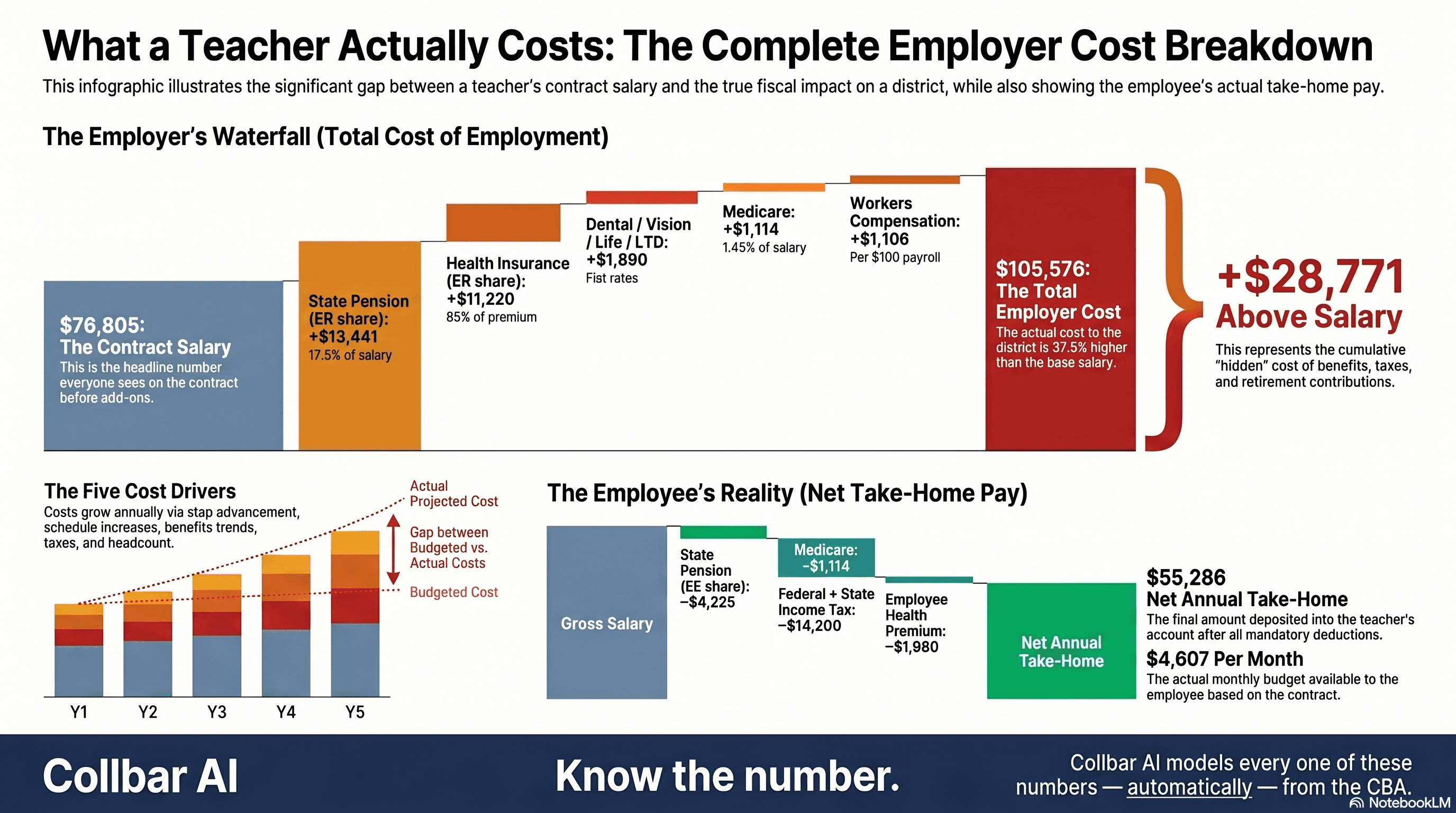
When a school board approves a teacher salary of $55,000, the actual employer cost is nowhere near $55,000. Many HR directors, finance officers, and elected officials dramatically underestimate the true total cost of employment for a single teacher — and this miscalculation cascades across multi-year budgets, collective bargaining negotiations, and taxpayer impact analyses.
This article breaks down every component of teacher compensation that hits your budget: base salary, step advancement, benefits, payroll taxes, retirement contributions, and leave liabilities. You'll learn the formulas to calculate total employer cost, see real-world examples with actual dollar amounts, and understand how to model cost growth across a three-year contract.
The Base Salary Misconception
Let's start with the most visible — and most misunderstood — number: the teacher's salary schedule.
In a typical school district, a teacher earns compensation according to a step-and-lane salary grid. Rows represent years of experience (steps 1 through 25+), and columns represent education level (BA, BA+15, BA+30, MA, MA+15, and sometimes EdD). A teacher on Step 5 with a Master's degree earns a specific amount from that cell in the grid.
A critical distinction that trips up even experienced administrators:
- Schedule increase: The grid itself changes. Every cell grows by, say, 2.5%. This is what unions negotiate.
- Step increase: A teacher automatically advances one row down the grid each year (unless the CBA contains a step freeze). This happens even if the schedule is frozen.
- Total increase: Both effects combined. This is what actually appears in the paycheck and the budget.
Example: A teacher at Step 4, MA lane earns $62,000 on the current schedule. Next year:
- Current grid shows Step 5, MA = $64,200 (2.5% schedule increase)
- But the teacher also moves from Step 4 to Step 5
- Combined effect: $62,000 → $64,200 = 3.5% to the individual teacher
- Budget impact: All steps move up, plus all teachers advance — this can easily be 4.5-5.5% of total payroll
Many boards approve a 2.5% schedule increase, thinking they've budgeted 2.5%. The actual cost is closer to 4.0% once step advancement is included.
The Retirement Contribution Multiplier
This is where the number gets large. Most teacher pension systems are not Social Security-funded. Instead, teachers contribute to a state-level pension fund (Illinois TRS, Ohio STRS, California CalSTRS, Pennsylvania PSERS, etc.).
In states with Social Security exemption, teachers pay NO Social Security tax at all — neither employee nor employer portions. Instead, the employer contributes a much larger percentage to the pension system.
Illinois Example (TRS)
- Employee contribution: 9.0% of salary
- Employer contribution: 0.58% of salary (local district)
- Plus: Illinois Teachers' Insecurity Fund (THIS Fund)
- Total pension cost: ~14-16% of salary
Many Illinois school districts pick up (pay on behalf of the teacher) the 9.0% employee contribution. This is a hidden compensation increase. The teacher sees $0 deducted, but the district's cost is:
Total Employer Cost for Pension = Base Salary × (0.58% + 9.0% + 1.0%)
Example: $62,000 × 10.58% = $6,559.60 per year
Ohio Example (STRS)
- Employee contribution: 14.0% of salary
- Employer contribution: 14.0% of salary
- Combined: 28.0% of salary — the highest in the nation
Ohio teachers typically pay their own 14% (it's deducted from their check), but the employer's 14% is a direct cost:
Ohio Employer Pension Cost = Base Salary × 14.0%
Example: $62,000 × 14.0% = $8,680 per year
Compare to a Social Security state like Pennsylvania:
- Pennsylvania PSERS employer rate: 35.26% (as of 2024-25) — but this is an unusually high crisis rate
- On top of this, teachers pay Social Security: 6.2% employee, 6.2% employer
- Total ER retirement + SS cost: 41.46% of salary
Pennsylvania is a cautionary tale. The pension fund is severely underfunded, and districts carry an enormous burden.
Payroll Taxes and Mandatory Withholding
Beyond the pension system, every employer pays:
Medicare
- Employee: 1.45% of salary
- Employer: 1.45% of salary
- Applies to all workers in all states
Social Security (where applicable)
- Employee: 6.2% of salary (up to $176,100 earnings cap in 2025)
- Employer: 6.2% of salary
- Does NOT apply in Social Security-exempt pension states: IL, OH, CA, TX, MA, CT, KY, LA, etc.
Example: Calculate Total Payroll Tax Burden
Teacher salary: $62,000 | State: Illinois (SS-exempt)
Medicare (Employer):        $62,000 × 1.45% = $899
Social Security:            $0 (exemption)
Illinois State Income Tax:   $62,000 × 4.95% = $3,069 (employer doesn't pay this)
Federal Withholding:        Varies

Total Employer Payroll Tax: $899 per year
Teacher salary: $62,000 | State: Pennsylvania (SS-paying)
Medicare (Employer):        $62,000 × 1.45% = $899
Social Security (Employer): $62,000 × 6.2% = $3,844
Pennsylvania State Tax:      Employer doesn't pay

Total Employer Payroll Tax: $4,743 per year
The Pennsylvania teacher adds $3,844 to employer cost just because the state system is underfunded and teachers pay Social Security on top of PSERS.
Health Insurance: The Second-Largest Cost Driver
Health insurance premiums are the second-largest component of total employer cost (after salary itself). In 2025, health insurance cost the typical school district:
| Benefit Tier | Annual Employer Cost |
|---|---|
| Single (Employee Only) | $9,600 |
| EE + Spouse | $19,200 |
| Employee + Children | $17,400 |
| Family (All Four) | $26,400 |
These are mid-market estimates for the Midwest. Urban districts and high-cost states (California, Massachusetts, New York) pay 20-40% more.
Understanding Premium Sharing
Most CBAs specify how premiums are shared. Common patterns:
- Percentage split: "District pays 85% of single premium, 80% of family" — as premiums rise, both sides share proportionally
- Dollar cap: "District contributes up to $15,000 per year" — increases above the cap fall entirely on the employee
- Tiered contribution: "District pays 100% of HMO, employee pays difference for PPO"
Default assumption (when CBA is silent): District pays 85% Single, 80% Family.
Workforce Composition and Average Cost
Not all teachers choose the same coverage level. A typical distribution:
- 35% Single coverage
- 25% EE + Spouse
- 40% Family coverage
For 100 teachers:
(35 × $9,600) + (25 × $19,200) + (40 × $26,400) = Weighted Average
$336,000 + $480,000 + $1,056,000 = $1,872,000 ÷ 100 = $18,720 per teacher
Average cost per teacher for health insurance: $18,720 per year (assuming 85% district contribution).
Benefits trend annually at 5.0-5.5% for commercial insurance. This means even with a salary freeze, your health insurance costs grow $900-$1,030 per employee per year.
Dental, Vision, Life Insurance, and Disability
Beyond medical insurance, districts also provide:
| Benefit | Single | Family | Employer Cost | Trend |
|---|---|---|---|---|
| Dental | $720/yr | $1,800/yr | 90% | 3.5% |
| Vision | $180/yr | $420/yr | 90% | 2.5% |
| Life Insurance | $50K coverage | — | 100% | 0% |
| LTD (Disability) | 0.6% of salary | — | 100% | 3.0% |
For a 100-teacher district with the distribution above:
Dental:       (35 × $720 × 90%) + (65 × $1,800 × 90%) = $130,680
Vision:       (35 × $180 × 90%) + (65 × $420 × 90%) = $32,670
Life:         100 × $300 = $30,000
LTD:          Avg Salary $62,000 × 0.6% × 100 = $37,200

Total Supplemental Benefits: $230,550 ÷ 100 = $2,305.50 per teacher
Leave and Substitute Teacher Costs
Every teacher uses leave: sick days, personal days, professional development, jury duty, bereavement. When a teacher is absent, the district pays a substitute.
Typical leave allocation (negotiated, varies widely):
| Leave Type | Days/Year | Sub Required? |
|---|---|---|
| Sick Leave | 10-15 | Yes |
| Personal Leave | 2-4 | Yes |
| Bereavement | 3-5 per occurrence | Yes |
| Professional Development | 2-5 | Sometimes |
| Jury Duty | As needed | Yes |
Average usage: 12 days per teacher per year requiring a substitute.
Substitute teacher pay (2024-25):
- Non-certified: $90-$150/day
- Certified substitute: $150-$200/day
- Long-term substitute (20+ days): $180-$250/day
Mid-market assumption: $150/day
For a 100-teacher district:
Substitute Cost = 100 teachers × 12 days × $150/day = $180,000 per year
Per-teacher allocation: $1,800/year
Accumulated Sick Leave Liability
Many CBAs allow teachers to accumulate unused sick leave year-over-year, and some districts cash it out at retirement. This creates a long-term liability.
A teacher with 20+ years accumulates 150-250 days of sick leave. If the district pays 50% of daily rate at retirement:
Sick Leave Payout = 200 days × ($62,000 ÷ 180 contract days) × 50%
                  = 200 × $344.44 × 50% = $34,444
For actuarial budget purposes, districts often reserve $3,000-$5,000 per employee for sick leave payout. For 100 teachers:
100 × $4,000 = $400,000 liability reserve (depreciated over 25-year career)
= $400,000 ÷ 25 = $16,000 annual accrual = $160 per teacher
Workers' Compensation Insurance
Teachers are classified under code 8868 (Public School Teachers) for workers' comp purposes. Rates vary by state but typically range from 0.30-0.80 per $100 of payroll, or roughly 0.5%.
For a 100-teacher district at average $62,000 salary:
Total Payroll = $6,200,000
Workers' Comp Rate = 0.5%
Annual Cost = $6,200,000 × 0.005 = $31,000
Per Teacher = $310/year
Some districts self-insure (common for larger districts), which shifts the actuarial risk internally but reduces premium costs by 10-15%.
Calculating True Total Cost of Employment
Now we can assemble the complete picture. For a single teacher earning $62,000 base salary:
| Cost Component | Amount | % of Salary |
|---|---|---|
| Base Salary | $62,000.00 | 100.0% |
| TRS Pension (IL example) | $6,559.60 | 10.58% |
| Medicare | $899.00 | 1.45% |
| Health Insurance (avg) | $18,720.00 | 30.19% |
| Dental/Vision/Life/LTD | $2,305.50 | 3.72% |
| Substitute Coverage | $1,800.00 | 2.90% |
| Sick Leave Accrual | $160.00 | 0.26% |
| Workers' Comp | $310.00 | 0.50% |
| TOTAL EMPLOYER COST | $92,753.10 | 149.6% |
Cost Multiplier: 1.496x
For every dollar of salary, the employer actually spends $1.50.
Scaling Across a School District
For 100 teachers at average $62,000 salary:
Total Base Payroll:     $6,200,000
Total Employer Cost:    $9,275,310
Incremental Cost:       $3,075,310 (50% above salary)
This $3.1 million in benefits, taxes, and leave costs is often the single biggest budget surprise for newly elected board members.
How Step Advancement and Schedule Increases Compound
Multi-year cost growth comes from five drivers:
- Step advancement (automatic, 1.5-3.0% annual)
- Schedule increase (negotiated, typically 0-3.5% annual)
- Lane movement (teachers earn degrees, 0.5-1.5% annual)
- Benefits trend (medical: 5-5.5%, dental: 3.5%, both mandatory)
- Headcount changes (hiring, retirements, attrition)
Three-Year Contract Example
Scenario: 100-teacher district, current average salary $62,000, 2.5% schedule increase per year, no changes to benefits.
Year 1:
Base payroll increase:          $6,200,000 × 2.5% = $155,000 (schedule)
Step advancement (2.0% avg):    $6,200,000 × 2.0% = $124,000
Benefits trend (5.0%):          $3,075,310 × 5.0% = $153,765
Total Year 1 Increase:          $432,765 (6.98% of total cost)
Year 2 (compounding on new base):
New payroll:                    $6,324,000 × 2.5% = $158,100
Step advancement:              $6,324,000 × 2.0% = $126,480
Benefits trend (5.0%):         $3,229,075 × 5.0% = $161,454
Total Year 2 Increase:         $446,034
Year 3:
Year 3 Increase: $460,615
Three-Year Total Cost Increase: $1,339,414 (21.6% of current total cost)
If the board budgets only for the 2.5% salary schedule increase, they've underestimated costs by $1.2 million over three years.
Why This Matters for Collective Bargaining
When you sit down with union negotiators, both sides must work from identical numbers. If management says "2.5% schedule increase costs $155,000 in Year 1" but the union says "No, it's closer to $280,000 when you include step advancement and benefits," the entire negotiation derails.
Transparent methodology is essential. Every scenario — whether it's a 2% salary increase, a benefits change, or a work rule modification — must show:
- Year 1 cost (salary component + benefits component + taxes)
- Multi-year cost (cumulative over contract duration)
- Cost per employee (dividing by total headcount)
- Cost per hour worked (total cost ÷ total hours, useful for comparing to other districts)
This is where most districts fail. Scenarios are often built in spreadsheets without clear documentation, making it impossible for unions to verify or management to defend.
Frequently Asked Questions
Can a district reduce total employer cost by freezing the salary schedule?
No — not completely. Step advancement continues automatically, and benefits trend (insurance premiums) continues regardless. A salary freeze on the grid stops the schedule increase but leaves 3-5% of payroll growth from steps and benefits trend. Total employer cost still grows 3-5% annually.
What happens if the district picks up employee pension contributions?
Total employer cost increases by the employee contribution rate. In Illinois, picking up the 9% TRS contribution adds $5,580/year per teacher (on $62K salary). This is a permanent, recurring cost, not a one-time bonus.
How do I account for turnover in cost projections?
Turnover saves money if new hires are paid less than departing employees. A Step 22 teacher earning $95,000 who retires and is replaced by a Step 1 teacher earning $42,000 saves $53,000 in salary alone — and proportionally on all benefits. However, turnover also costs money (recruiting, training). Use 8% average annual turnover as a baseline, with higher rates in early career and pre-retirement stages.
Does the district pay Social Security for teachers?
Only in states where teachers pay into Social Security, not a state pension system. In Illinois, Ohio, California, Texas, Massachusetts, Connecticut, and 14 other states, teachers are exempt — neither employee nor employer pays Social Security. Always verify your specific state system.
What's the industry standard for health insurance premium sharing?
There is no true standard, but typical patterns are: district pays 85% Single, 80% EE+Spouse, 75-80% Family. Some progressive districts pay higher percentages; conservative districts use dollar caps. Request comparable agency data from your state ASBO chapter or AASA network.
How accurate is my cost projection if I don't include benefits trend?
Very inaccurate. Medical insurance trends 5-5.5% annually, compounding. Over a 3-year contract, ignoring benefits trend understates employer cost by $400,000-$600,000 on a 100-teacher payroll. Always include trend separately from salary increases.
Why do some districts show lower per-teacher costs than others?
Six factors drive variation: (1) pension system (PSERS = 35%+ vs. TRS = 10%), (2) health insurance premium level (rural $8K vs. urban $12K), (3) degree mix (higher MA = higher pension contribution), (4) seniority distribution (older workforce = higher salary + higher benefits usage), (5) benefits design (generous sick leave = high accrual liability), (6) state taxes and SUTA rates.
Key Takeaways
- Total employer cost for a $62,000 teacher is approximately $92,750 (1.5x multiplier), not $62,000. Boards frequently misunderstand this 50% gap.
- Pension contributions are the largest single addition to salary costs, ranging from 10% (Illinois TRS) to 35%+ (Pennsylvania PSERS). In Social Security-exempt states, pensioning adds 12-16% to salary cost on top of base pay.
- Health insurance is the second-largest cost driver (30% of salary), growing 5%+ annually independent of salary increases. A $155,000 salary increase in Year 1 is accompanied by a $154,000 benefits trend increase.
- Step advancement is automatic and guaranteed, adding 1.5-3.0% to payroll annually even with a frozen schedule. A 2.5% schedule increase actually costs 4-5% when steps are included.
- Transparent cost modeling is non-negotiable in collective bargaining. Both management and union must verify every formula and assumption. A three-year contract underbudgeted by even $200,000 cascades into mid-year cutbacks, grievances, or tax levy increases.
How CollBar Can Help
Calculating true total cost of employment is complex, but it's essential for strategic budgeting and defensible contract negotiations. CollBar's compensation studies services provide data-driven analysis of your specific cost structure, comparable agency benchmarking, and scenario modeling for any proposed contract change. Our AI-powered cost modeling platform allows you to update assumptions in real time and instantly see multi-year financial impact — giving both management and union accurate, auditable figures at the bargaining table.
Whether you're preparing for negotiations, validating a union proposal, or explaining budget constraints to your board, CollBar delivers the transparent methodology and specific numbers you need to make informed decisions.
Ready to understand your true labor costs? Call CollBar at (419) 350-8420 to schedule a free strategy session. We'll review your current salary schedules, benefits structure, and pension obligations, then show you exactly where your incremental costs are coming from — and where you have leverage in negotiations.